Showing posts with label Islay. Show all posts

Friday, 12 November 2021

Bruichladdich Biodynamic Project

Last week I attended the Glasgow launch of Bruichladdich's new Biodynamic malt at Rémy Cointreau's offices in Blythswood Square.

There were wonderful canapés provided by Fallachan (that Chicken of the Wood - good lord what a flavour), excellent mixed drinks by (my colleague) Danny McManus, and I had several fascinating conversations with different 'Laddie folks around the topics of biodynamics and sustainable agriculture. We even drifted slightly into terroir territory. But most importantly, we tasted the whisky.


We were joined from the Bruichladdich distillery by head distiller Adam Hannett, who talked us through the growing of the barley and the making of the whisky.

Here are the facts I found most interesting or important about this new whisky:

  • Biodynamically grown barley gave Bruichladdich higher yields than conventionally grown crops of the same variety.
  • The whisky making isn't biodynamic, just the farming of the barley itself. Adam says that, with Bruichladdich making so many different expressions, they prefer to keep the brewing and distilling processes the same, since they're focused on barley varieties, locations (the T-word again), and barrel type. Although he's not ruling out future experiments with yeasts...
  • As yet, Bruichladdich doesn't have any Scottish biodynamic growers, so for this cuvée they sourced the barley from Yatesbury House Farm in Wiltshire. It's their only expression not made with Scottish barley, and I did rather get the impression that Bruichladdich is a little unsure of how their fans and followers will respond to that point of difference.

Tasting Notes

This is a cask sample at 55%, whereas the finished product will be bottled at 50%. It was distilled in 2011 from a variety called Westminster, and the whole batch has been matured in first fill ex bourbon barrels.

To nose, it's bright and fresh, with a slight initial spirity fire. There's a load of sweet dried grass or haylage, plus a real honey sweetness. Over time, fruitiness develops - peaches, stone fruits, ripe yellow orchard fruits.

With water there's more fruit and less grassiness, and I also found a floral note; specifically roses.

The palate is full bodied, very sweet, and mouth coating. I'm reminded of vanilla ice cream and peaches. There is a drying oak note in the finish, which is more emphatic with water. As with the nose, adding water brings out more fruit character - ripe yellow apples, peaches, and other stone fruits.

In conclusion, I enjoyed this whisky very much. Comparing this with other expressions of the 'Laddie, I'd say it has a really rich, mouth coating texture — oily, even. It also seems sweeter than most, and I didn't find any of the lactic or funky notes that I would often associate with the distillery. Excellent, would recommend.

You can read more about this whisky on Bruichladdich's website.

Wednesday, 17 October 2018

Five Kilchomans

On September 24th George Wills visited the Good Spirits Co. in September 2018 as part of the Kilchoman Land Rover Tour. He's an extremely amiable chap, and a very entertaining speaker. These notes were written after the tasting had finished, whilst in conversation with a colleague, so I hope I wasn't too influenced by Mr Wills's bonhomie.


Kilchoman 100% Seventh Release, 50%
(having a half bottle of the previous batch of the 100% Islay to hand, it seemed only sensible to make the comparison. Although more than half full, it had been open for several months, possibly nearly a year, so I assume there's been some oxidation)
Nose: salty and coastal rather than overtly peaty (to be expected, given the lower peating level for Kilchoman's floor malted barley). Sharp, citric, & green. Banana goop. Waxy candles. A note of decayed vegetation.
Palate: Rounded & oily. There's plenty of vanilla, pepper, and an enjoyable funky note which I think relates to the decayed vegetation I found on the nose.
Conclusion: Tasty, but also somewhat raw. I like the green aspect.

Kilchoman 100% Islay Eighth Release, 50%
Nose: again, it's initially salty and coastal before sweet mellow peat comes in to play. There's a touch of the waxy candles found in the Seventh Release, but it ain't so strong.
Palate: fruity and rounded, with gentle peat and some hard to tease out (hence intriguing) funk. The finish is a bit aggressive.
Conclusion: I think I prefer the Seventh Release - but perhaps just because it's had a good airing?

Kilchoman Loch Gorm 2018, 46%
Nose: Wow, this is really funky. Kinda stinky like high ester Jamaican rums (Dunder!). Really, this is verging on Ledaig levels of funkiness. There's a mineral quality which I asssociate with sherry barrels too - unfortunately, I can't find a better word for it than petrol. (petrol as a tasting note is usually associated with the presence of terpenes, most often in relation to Riesling. But terpenes are found in sherries - see here and here for more information). There's also the classic sherry barrel note of struck matches. And lots of funk.
Palate: it's very sweet, but that's balanced by the salty character of the peat. It's also slightly on the sulphurous side - well within my sulphur comfort zone, but definitely not for everyone. Alongside the typical Kilchoman grassy funk, there is allso plenty of caramel and chocolate.
Conclusion: I love sherry and peat! This is a great example of the style, only let down by being a bit nippy in the finish.

Kilchoman Land Rover Tour 2018, 59.8%
(In other words, cask strength Machir Bay)
Nose: posh smoky vodka. Peat and funk. New make. Young, raw. Hairspray! (a note I find from time to time in Brackla. I have no idea what the common factor between Kilchoman and Brackla could possibly be). There's still plenty of the Kilchoman grassy funk.
Palate: Youthful. Raw. Hot and salty. With water it becomes much sweeter and less raw
Conclusion: what was that Ian Banks book again? Oh yes, "Raw Spirit".


Kilchoman Sauternes Finish Cask Sample
(we were given this in lieu of the forthcoming Sauternes finished release, which isn't bottled yet. And yes, it's not in the picture. Nevertheless.)
Nose: sweet grassy smoke. Very clean - there seems to be rather less of the Kilchoman funk in this one. There's an oaky spiciness which reminds me of Lagavulin. With water it becomes syrup-sweet, and the peat smoke dies down.
Palate: wow, this is super sweet - icing sugar, jelly babies (yellow ones). It's light bodied and rather nippy. Interestingly, the aftertaste is much more about the savoury peat, which (unusually) is verging on umami. With water it seems to go from syrup to toffee, almost  into treacle. It's still nippy, and the oak spice has veered off into Oddfellows territory. The finish is a much more familiar earthy peat.
Conclusion: a decent dram, not too complex. Not my kind of whisky, apparently.

Of the five drams, I think my favourite on the night was the 100% Islay Seventh Release. I suspect this might be as much to do with what I'm enjoying at the moment, which seems to be veering slightly away from monster cask strength whisky.

I've had a bottle of the Land Rover Tour Machir Bay before (here's a video review by the Whisky Wuman) and I reckon I liked that quite a bit more than this year's.

If you like your peaty malts to have a bit of funk about them then you should definitely try Kilchoman. Also, they have absolutely the best artwork of any distillery showing how whisky is made. Check it out here. I can't find it! I do hope they haven't ditched it. Awww man, I think they've ditched it.

Sunday, 5 November 2017

What's The Point Of Ardbeg An Oa?

For more than two and a half centuries Scotch Whisky—I mean the industry, not the drink itself or the culture—has moved in cycles or waves of popularity, expansion, and prosperity for distillers, followed by slump and closures.

Some producers have taken advantage of the current upturn of the wheel to try and move their whisky up-market. In the (very successful) case of Ardbeg, this move began, I seem to remember, in the early 2000s, and over the course of a few years the price of Ardbeg Ten drifted upwards relative to other Islay brands. The invention of the annual Ardbeg Day release, and the introduction of Ardbeg embassies helped push the price increases, by building an air of exclusivity.

I suppose Ardbeg can't really be faulted for this. After all, corporations are obliged above all else to maximise their profits, and Louis Vuitton Moët Hennessy operate in the luxury market, where the price and the utility of a good are but loosely connected, so why not see how far you can go?

So we have had a succession of releases of varying quality, some excellent, some anodyne, none sensibly priced, but one thing that all the previous Ardbeg Day specials did have was a decent level of the sweet smokiness that helps to place Ardbeg in the front rank of Scotch Whisky distilleries.

And this is where I found myself bamboozled by the new permanent addition to the core range, An Oa. It just doesn't have that same intensity of peat.

The nose in particular is very mild mannered, to the point of blandness. Honestly, it's faintly coastal, and that's it.

The palate is much better: sweet and smooth, with salty peat. It's very fruity too - lovely yellow fruits (yellow brambles, if they existed). The aftertaste is clean, peaty, and a little salty. But still and all, it's mild.

Ardbeg-lite.

And there's when I realised what the point of Ardbeg An Oa really is.

It's the brand extension for people who don't particularly care for smoke. Just as Brockman's is a gin for folk who dislike juniper, or skittle vodka exists to hide the unpleasant taste of alcohol, An Oa opens up the world of peaty drams to a whole bunch of people who wouldn't otherwise buy them.

So there you have it. Mystery explained. LVMH aren't about flavour, and it doesn't make sense to think about their products like that, or to question the introduction of an Ardbeg which doesn't taste much like Ardbeg.

And with that question resolved, I'm off to drink a Ledaig.

Monday, 9 January 2017

Port Ellen 37 Year Old

We had been promised a taste of all of the 2016 Special Releases, but owing to some double booking or some such by our host, only the Port Ellen was on hand. This did have the unlooked for - but very much appreciated - consequence that we all got whisky cocktails for free. To use the vernacular, result.

The Port Ellen, at 37 years old, smelt surprisingly peaty. Fairly intense fruity salt dominated, but there was a load of underlying peat, and behind all that some elegant oak perfume. All in all the nose was very broad and direct, like a chunk of overly salty fudge.

Without water the palate was nippy. I found grass, boiled sweets, fusty old oak and salty malt, but very little earthy peat. Water improved this dram immensely, making it soft, rounded, and even more salty. It was remarkable just how salty it was without being peaty or smoky.

I've tasted Port Ellen a handful of times, and always enjoyed it. This dram was excellent, although of course I didn't pay for it (and wouldn't, at the asking price). It did seem surprisingly peaty for a 37 year old, which rather made me wonder if the whisky was racked into freshly emptied Caol Ila or Lagavulin casks at some point. I don't suppose I'll ever find out.

Friday, 11 November 2016

ralfy.com Port Charlotte 12 Year Old

YouTube superstar Ralfy popped into the shop to say hello, and very kindly shared a delicious peaty dram with us.


It's a private cask of Port Charlotte, bottled to mark the achievement of a new world record at Bonneville this September past, vintage motorcycles being Ralfy's other obsession.


Ralfy has picked a fantastic cask to bottle, the kind of clean, fresh ex-sherry cask which adds so much to a whisky without dominating the spirit character.

The nose is salty and rich and slightly waxy. There's the characteristic sherry cask chocolate note which to me is always reminiscent of cheap instant chocolate pudding - you know, Angel Delight or Miracle Whip or similar. There's also just enough old cask smell or fustiness. Not too much, just enough.

The palate is sweet and rounded and chocolatey, before evolving into a snuffed out candle smoke taste. Delicious.

It's a very, very fine Port Charlotte, by far the best I've yet tasted. Good work on securing that cask, Ralfy, and can I have some more please?

Postscript: A couple of days later I was talking to Ralfy again and he told me that, according to staff from Bruichladdich who were at Glasgow's Whisky Festival, some of these private casks of Port Charlotte were actually filled with Octomore (due to a shortage of PC spirit). Which might explain the intense peat character of this dram, coming as it does from a pretty active cask.

Saturday, 15 October 2016

Tasting Note: Kilchoman Cask Strength Quarter Cask

Despite being up and running for some eleven years, Kilchoman don't seem to have any plans for a standard ten year old release yet. I don't consider this necessarily a bad thing. Apart from the first few youthful bottlings, which I found as rough as an agricultural salt lick, I reckon that Kilchoman tastes very good at four or five or six years old.


The nose is sweet – banana cream with some salty earthy peat underneath., then the peat seems to get more floral. Iodically floral. Adding water makes it spirity, but also fresh and airy.

The palate is very, very sweet, soft, and drinkable. There's loads of earthy peat. It leaves a saltiness behind (or more precisely a salt-sweet note), plus a chili burn. With water it is still very sweet, light bodied, a little hotter than without water. The peat seems saltier – more sea air than earthy. Finish is now oddly drying. With time I'm starting to see some fruity notes, but the finish is definitely a bit rougher once water is added.

To conclude. A quarter cask expression seems like a good way to bring on maturing spirit more rapidly. I've always been a fan of the Laphroaig Quarter Cask, which is said to be about six years old, and I've tasted some delicious young octaves from Glenglassaugh. I like this expression a lot.

Monday, 18 January 2016

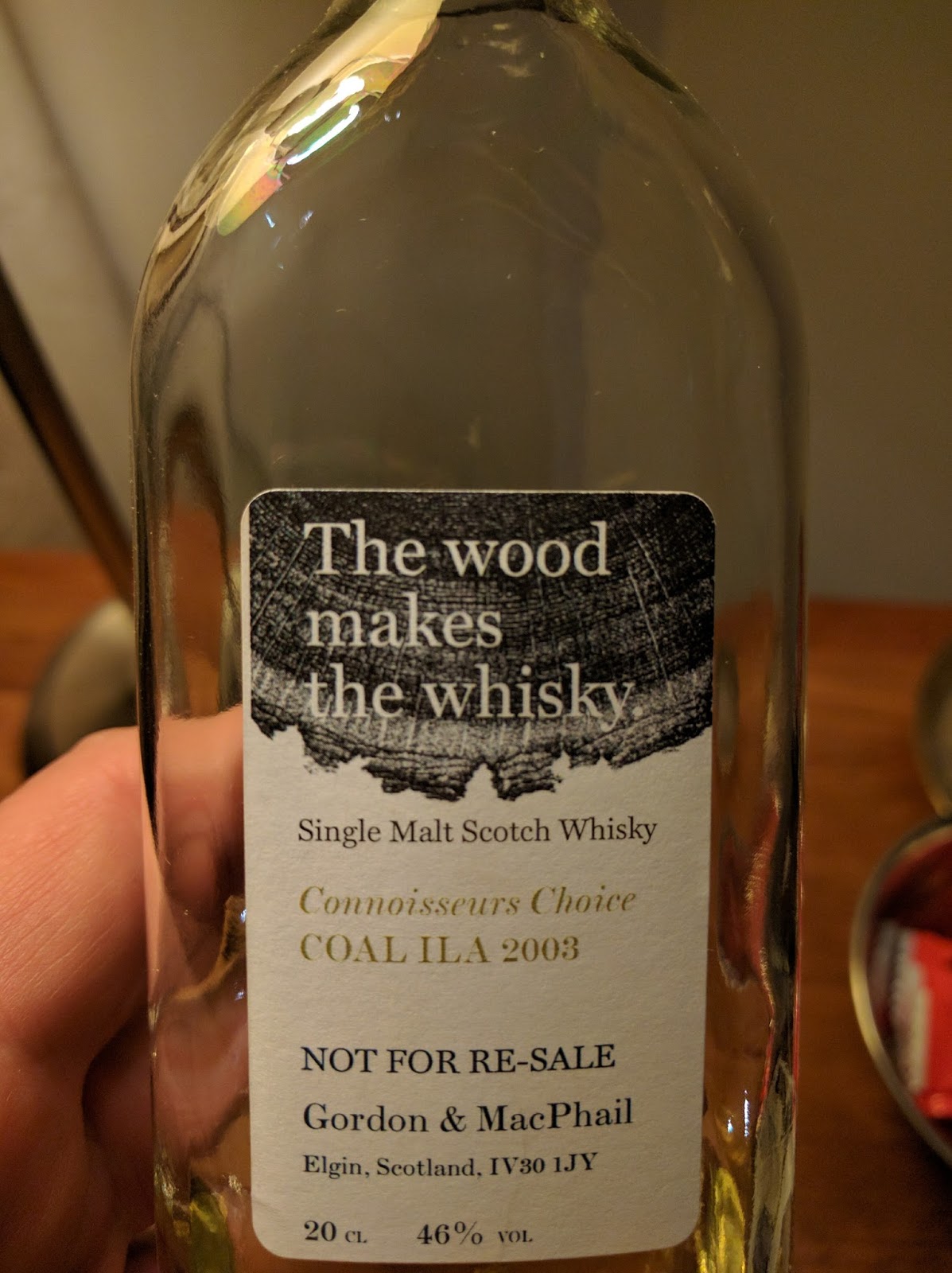
The Wood Makes The Whisky

If that's the best you can offer then I really do think you're doing it all wrong.

If you're claiming that 60% of the flavour in a malt comes from the wood, then stop what you're doing and go and learn how to make a flavoursome distillate!


A case in point is this tasty dram. If you were to offer it to a hundred people, whisky fans and non whisky drinkers alike, I doubt you'd even get one person calling it woody, or oaky, or spicy, or bourbon-like. In this case, "The Peat Makes the Whisky".

It's a classic Caol Ila, salty-sweet, coastal, iodic, peaty. Is there any discernable oak influence? Pfft.

Saturday, 10 April 2010

Distillers Editions Worth Their Weight

Diageo don't have a great reputation here in Scotland. The brutal self-interest which has led them to announce the closure of their Kilmarnock operation is a case in point. But it cannot be denied that they produce some superb whiskies.

It was the 1986/2002 Lagavulin Distillers Edition which made me sit up, pay attention, and start tasting whisky seriously. (A more accurate description would be to say that I fell into the whisky for a minute or so, becoming completely oblivious to the crowd of 1000 jolly, drunk people around me)

At a whisky dinner I hosted at The Bothy back in February the dram of the night was the Clynelish Distillers Edition. It outshone even the Highland Park 18 Year Old, a whisky which has more than once been called the best in the world.

Tonight's example, the Caol Ila Distillers Edition, maintains that standard. It is a profound dram, the nose an intense swirl of sweet bacon wood smoke, with a briney tang like the saltiness when you are swimming in the sea and accidentally swallow some seawater.

The palate is at once sweet and oily and salty and smoky, long lasting, with a hit of pepper in the finish. The flavours persist for more than a minute, and the smokiness for nearly three.

Compared to the twelve year old expression , the Distillers Edition is more intense, longer lasting, bigger, more complex; still the same whisky, but with the intensity turned up to eleven.

I haven't tasted any of the Manager's Choice whiskies, but it is hard to see, at the price being asked, that they can be anything but an exercise in separating collectors from their money, when such gems as the DEs are available for a fifth of the price