Showing posts with label Lowlands. Show all posts

Tuesday, 14 February 2017

Why Kennetpans Matters

Don't feel too bad if you have never heard of Kennetpans, since it doesn't really feature prominently in many histories of Scotch. But please!, do read on to find out what you should know about it, and why.
Kennetpans Distillery: the mill, engine room, and stillhouse

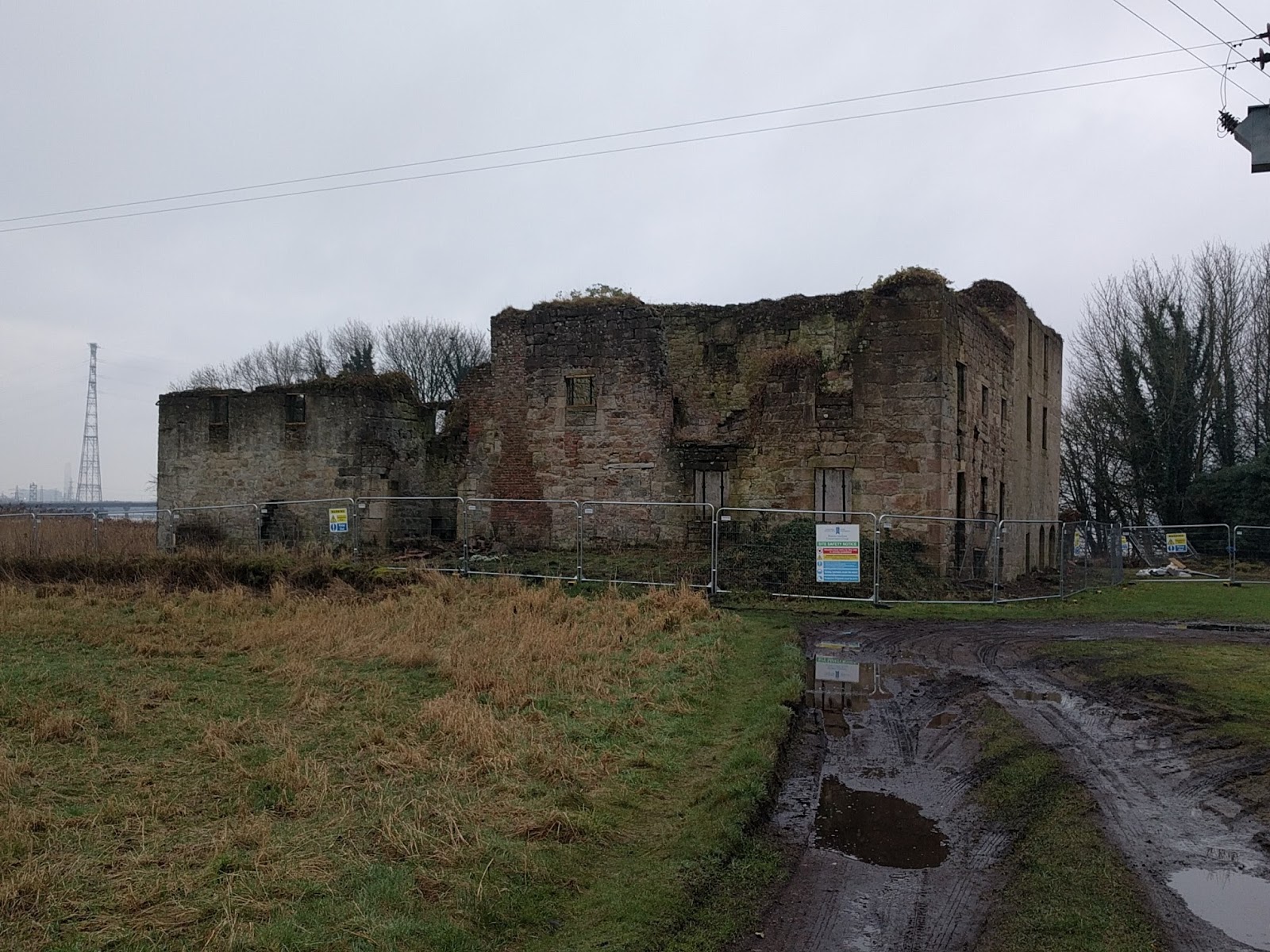
Along with a colleague I was lucky enough to be invited to visit the ruins of Kennetpans distillery last week. It's in something of a parlous state, with parts of it close to collapse. Considering how central it is to the history of the Scotch whisky industry, that's a crying shame.


That's a fifteen foot diameter flywheel cutout

The Haig and Stein families were the original whisky barons, dominating the nascent industry from the 1750s through to the mid nineteenth century. Kennetpans in its heyday was a huge distillery; the Scotch Whisky Industry Record states that in 1773 it employed over 300 men and produced upwards of 3000 tons of proof spirit (which, cross referencing with government records, implies that it produced a fifth of all the spirit consumed in Great Britain in that year. A fifth.)

Massive stone piers supported the Watt steam engine

The first Watt steam engine in Scotland was built at Kennetpans in 1786. The canal between Kennetpans and its even larger successor, Kilbagie, was one of the earliest in Scotland, and built ten years before the Forth and Clyde canal. The first railway in Scotland ran between the two distilleries.

Part of a millstone. And a rusted fragment of the iron band which held it.

Even more fundamental to the Scotch whisky industry, the Stein Patent Still, forerunner to the Coffey still which continues to be used to this day, was developed at Kilbagie.

Remnants of the pier where ships took on their cargo of whisky.

This last development, the high volume (and low flavour!) continuous still, perhaps points to the reason why Kennetpans has been forgotten. It, along with many of the other Lowland distilleries, spent much of its working life churning out cheap, poor quality spirit which was much more likely to be rectified into gin than to be drunk as whisky. And that side of the whisky business, the vast bulk of cheap blended Scotch, with minimal malt content, is one that the industry just doesn't bother to talk about.
Inside the maltings.

Kilbagie is long gone; demolished, built over, and built over again. But much of the structure of Kennetpans is still standing—just barely—and it's still possible to see evidence of the different activities that went on there. The massive piers which supported the steam engine are incredibly impressive, until you see the size of the maltings, and consider that they were said to be five stories high.

One of the many huge cracks in the structure

Even in its decayed state, Kennetpans still has the power to impress. If it were to be stabilised and made safe, so that people could visit and learn of the earliest days of the Scotch whisky industry, I think that would be a very good thing indeed.

About Kennetpans
As is so often the case with Scottish distilleries, the foundation date for Kennetpans isn't known, but by the 1730s it was was the biggest distillery in Scotland. It was closed by John Stein Jr. in 1825 or '26.

You can learn much more about Kennetpans and the Haig and Stein families at the Kennetpans trust website, where you can also make a donation to support the work of rescuing the structure.

Wednesday, 21 September 2016

Distillery Visit: Glenkinchie


I'm probably the wrong person to report on a visit to Glenkinchie. I'm no fan of the whisky, and I don't much care for Diageo either. These caveats aside, there were aspects of the visit that I enjoyed.

(I should say, by the way, that I completely failed to get any good pictures. Diageo, of course, have a blanket ban on photography in production areas or warehousing, but that aside, I failed. I took the distillery bus from Edinburgh, which gives you very little time to wander about. And Glenkinchie is tucked into a wee valley which doesn't offer many telephoto opportunities.)

The first pleasant surprise of the tour was meeting the guide, an ex-colleague from Oddbins days. She knew of old my penchant for pedantry in the nth degree, and was very tolerant of my questions. And, as is nearly always the case with Diageo, the tour script was factually accurate, concise, and very clear. It was great to see the huge wash still (30,963 litres—biggest in Scotland), which hinted at the historical role of Lowland distilleries as volume producers of low quality spirit.

I also enjoyed the tasting at the end of the tour. The bar at Glenkinchie has a very good selection of Distillers Editions and Flora & Fauna bottlings, which isn't always the case. After trying the Glenkinchie 12 (workmanlike) and Glenkinchie Distillers Edition (decent sherry casks, no spirit character) I had a Benrinnes 15 (always a pleasure, at least until 2020 or thereabouts, when the last of the spirit produced by partial triple distillation is finished) and a Lagavulin Distillers Edition.

I always think of Lagavulin as the malt whisky equivalent of Guinness in a crap pub, so to extend the metaphor, Lagavulin Distillers Edition is like going into a pub and finding unpasteurised Guinness, or Guinness Foreign Extra, on tap. In other words, a surprise and a delight.

On the down side, the warehouse we were shown seemed awfully Potemkin village. There was a remarkable absence of dust, dirt, or Baudoinia compniacensis. And when I looked up I could see plenty of daylight through the gaps between the floorboards, which rather implies that the upper warehouse floors are empty.

I also happened across a couple of interesting snippets. The first of these was a Heath Robinson print, about an imagined redesign of the Johnny Walker bottle.


I'm a huge fan of Heath Robinson, so this made me grin. (can you see me grinning in the reflected image?)

The second was this manufacturer's plate on a filter (for worts, I suppose).


Royal Letters Patent
Magnien's
Filtre Rapide
No.2
P.A.Magnien
22-23 Great Tower Street London
Manufactured Aboad

I don't know why, but to me words like these from the past have a very strong appeal.

In summary, this is a great tour for visitors to Scotland. You can be picked up from Edinburgh and be back in the city centre in an afternoon, having enjoyed an imformative trip at a pretty distillery, plus a few acceptable-to-decent drams. For the seasoned malt drinker (as for me), Glenkinchie's main appeal is to add a stamp to your Classic Malts passport.